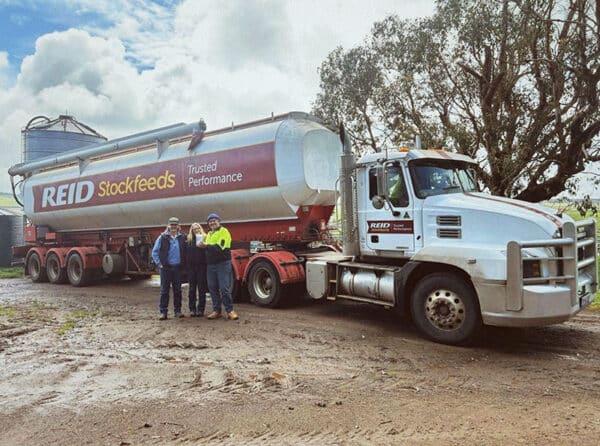
Reid Stockfeeds recently had the privilege of 2nd year Agribusiness student, Jack Liston, join us from Marcus Oldham College for a two-week work placement.
Jack is from a Wheat and Sheep farm near Skipton in Victoria and has future ambitions to get into grain accumulation, then eventually go back into the family business. Across the two weeks, Jack’s been exposed to the inner machinations of a busy stockfeed business. He has spent his time within different departments meeting with employees and customers alike which has given him a broader understanding around the importance of relationships.
Being a student and young farmer, Jack has given us his perspective on current grain markets and what the market climate could look like in the weeks ahead.
We have enjoyed immensely having Jack with us and wish him all the very best in his future endeavours.

Where is the farmer a seller?
Despite a broadly bearish market outlook, many growers remain cautious sellers. Sellers were initially cautious off the back of early-season dry conditions, holding back grain amid uncertainty. However, recent rainfall across Victoria and South Australia may improve confidence, shifting sentiment. With the new crop edging closer to harvest, growers are now more willing to engage the market and consider forward selling.
Growers are still coming to the table with some old crop tonnes, largely due to the weight of historically high carry-out stocks along the East Coast. Domestic demand from feedlots, poultry operations, and flour millers continues to absorb a meaningful share of grain, providing a measure of liquidity. However, new-crop 2025/26 sales remain limited to small parcels, mostly from growers hedging early positions as opposed to committing to significant volumes early.
Input costs are another key deterrent. With urea priced around $810 per tonne and phosphate (MAP/DAP) products near $1,200 during sowing times, growers are facing decile-9 cost structures. When these elevated expenses are set against current bearish local grain prices, gross margins per hectare are severely compressed. Growers may remain sceptical to lock in prices that could promote poor returns. Instead, many are adopting a wait-and-see approach, balancing risk management with the possibility of stronger markets later in the season. Yet with interest rates at 3.6% and edging down 25 basis points in August, the weight of finance remains in the background — a reminder that growers will eventually need to step forward as sellers to meet ongoing overheads and variable costs.
In recent times some stability has crept back into the market after seeing price volatility with covid and more recently Trumps trade wars. This has seen prices soften in domestic and international markets. With increased carry out some growth may have increased expectations of some price volatility, in order to chase premium markets.
Are we there yet?
Southern Queensland harvest is imminent with Northern NSW to soon follow suit. Generally speaking, the northern growing regions have yet again produced some spectacular crops. Western Australia remains the standout, with ample rainfall sustaining strong yield prospects across wheat, barley, and canola, despite growers now wanting sunshine after Perth’s wettest winter in three decades. In the east, southern Queensland and central Queensland are earliest to harvest, with above-average yields expected, though prices remain close to breakeven. Northern New South Wales has benefited from rainfall and is forecast to deliver large volumes of sorghum and wheat, while southern NSW—despite recent dryness—should see recovery with 20–40mm forecast. Victoria and South Australia, initially dry, have improved sharply with recent rain, pointing to strong canola and pulse output. Nationally, wheat exports are projected above 23 Mt, with WA leading in barley, NSW and Qld dominating sorghum, and Victoria/South Australia driving canola volumes, reflecting a broad regional expansion despite localised production challenges.
Victoria’s 2025 cropping outlook has improved significantly after early-season dryness threatened yields in the Wimmera and Western Districts. Widespread late winter and spring rainfall has reinvigorated crop potential, positioning the state for strong wheat and barley production, particularly in medium-rainfall zones. Canola is performing well across the Western Districts, supported by solid subsoil moisture and favourable growing conditions. Pulses, including faba beans and lentils in the Mallee and Wimmera, are also in good shape, though softer prices weigh on grower returns. Overall, Victoria is expected to be a leading contributor to national canola and pulse output, alongside a solid cereals harvest.
Global grain markets remain under pressure as larger northern and southern hemisphere crops meet sluggish demand growth, weighing on export values and local cash prices.
Wheat: Production across the top exporters – Black Sea, US, EU, Canada, Australia, and Argentina – is forecast 12Mt higher year-on-year, while import demand among the top 12 buyers is only expected to rise 6.5Mt. Russian FOB values continue to dictate global direction, easing to ~US$225/t, down US$15 on the month. Locally, new crop track and delivered values have fallen A$20–30/t over the past month. The AUD breaking above US$0.66 has further pressured export competitiveness. While near-term rallies look unlikely, slow farmer selling and weather risks remain potential supports.
Feed Grains: Global barley output has been revised up 3Mt to 147.3Mt, with Australia forecast at a record 15Mt, slightly above ABARES estimates. Domestic barley cash values have softened, with China’s buying ideas slipping to ~US$245 C&F. Sorghum markets remain thinly traded, with new crop offers at A$315–320 delivered Downs/NSW for Mar–Apr, though volumes are yet to flow. China’s approval of Brazilian sorghum is more symbolic than material, leaving Australia well-placed to service Asian feed demand. Soymeal prices have plummeted in recent weeks as a result of large global supply and foreign exchange rates.
Pulses: Faba bean bids remain static at A$390–400/t, with ABARES forecasting an 854,000t crop (+100,000t y/y). Chickpeas have weakened on a 2.1Mt forecast and wetter weather risks.
Canola: Canadian canola is down 7%, EU yields are higher, and ABARES pegs Australia’s crop at 6.78Mt, well above the 10-year average. Heavy global supply continues to cap prices despite growers holding back sales.
To increase your livestock farming gains & expert nutritional feeding advice please call 1300 REID FEED or enquire here >
Author
Jack Liston
Marcus Oldham Agribusiness student